Colours of the Inner World
Best Abstract Painting
For Trần Tuấn, painting was a way of looking inward. Born in Hải Phòng in 1961 and later based in Hanoi, the late Vietnamese artist spent more than five decades building a practice defined by colour, silence and spiritual reflection. Trained in fine art and recognised as a member of the Vietnam Fine Arts Association, he moved gradually from figurative painting toward a deeply personal form of abstraction inspired by Eastern thought.
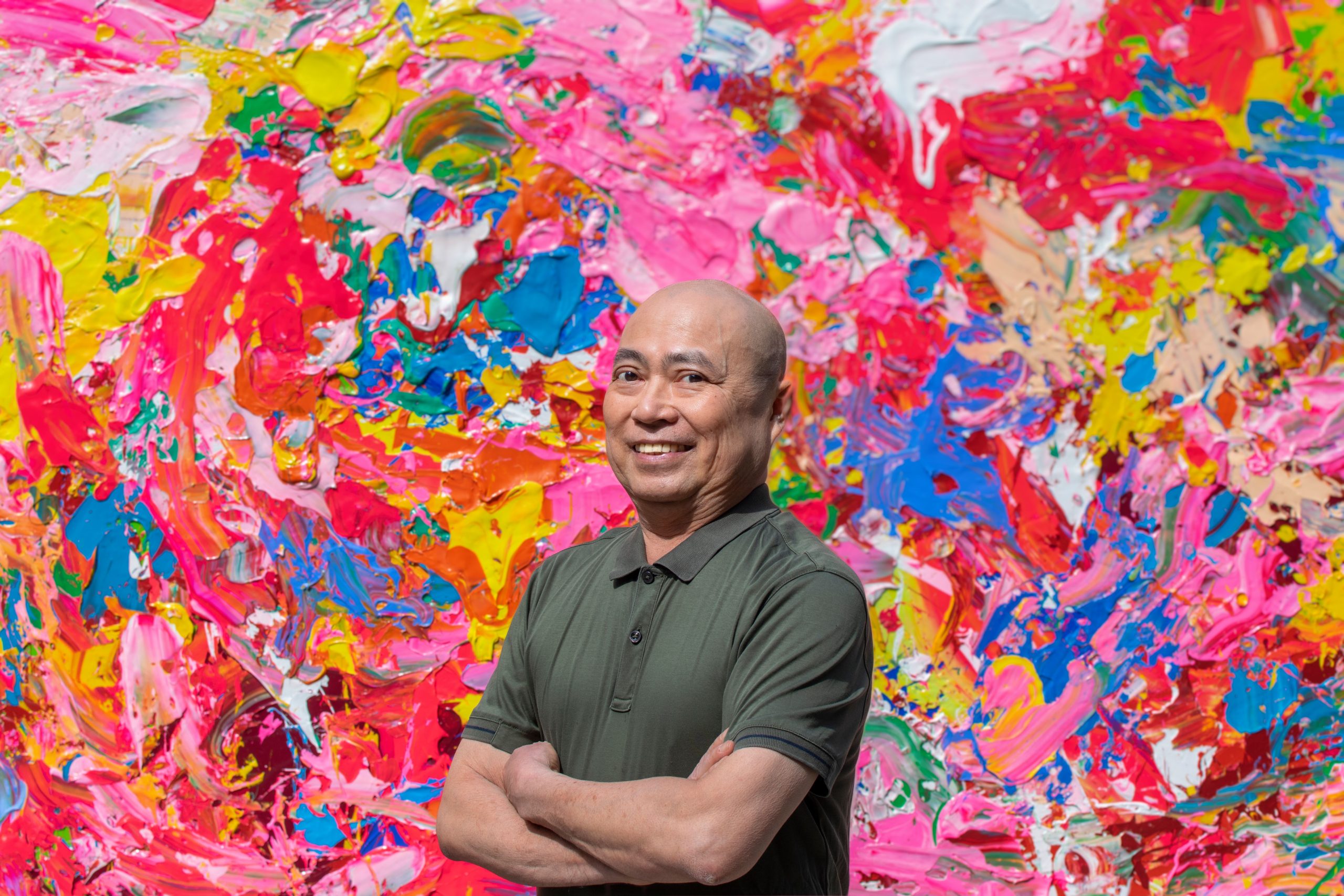
At first glance, his works may seem quiet, even minimal. Yet the longer one looks, the more they begin to open. Layers of translucent colour gather, drift and vibrate across the canvas, creating spaces that feel calm but never empty. His paintings do not depend on dramatic contrast or obvious narrative. Instead, they invite a slower encounter, where colour becomes atmosphere and silence becomes emotion.
Trần Tuấn once described his art as “a closed eye” looking into his own soul. This idea reveals the essence of his work. He did not paint simply to represent the outside world, but to explore memory, consciousness and the unseen movement of inner life. His abstract compositions often feel like meditative landscapes, places where the viewer can enter gently and remain for a while.
Although he mastered both figurative and non-figurative styles, his later practice became increasingly open and spacious. Human figures gradually disappeared, giving way to fields of light, movement and cosmic rhythm. In works such as Symphony of the Universe and Melody of the Stars, colour suggests not only beauty, but also a search for harmony, enlightenment and happiness.
Throughout his career, Trần Tuấn held six solo exhibitions, including Một Chặng Đường Hội Họa, Chiều Đỏ, Niềm Vui Sống and Nhân Gian. He also participated in important group exhibitions in Vietnam and abroad, with works shown in London, Paris, New York and Rome. His painting My Hanoi City was recognised by Saatchi Gallery in the international Bright Light – Big City competition, while his later work also received recognition through the ITSLIQUID Exhibitions Program in Rome.
After his passing in 2024, the Vietnam Fine Arts Museum presented Trần Tuấn: Sắc Và Không – Phần I, a retrospective bringing together 47 works from different periods of his artistic journey. The exhibition allowed audiences to see the full arc of his practice, from earlier explorations to the luminous abstract works that came to define his legacy.
What remains most powerful in Trần Tuấn’s art is its sense of inner peace. His paintings are vivid, but not loud; spiritual, but not distant. They speak through rhythm, colour and quiet intensity. In a world often shaped by speed and noise, his work offers another way of seeing: slower, deeper and more reflective.
Through his long artistic life, Trần Tuấn created a language of abstraction that feels both intimate and universal. His paintings continue to remind us that colour can hold memory, silence can carry meaning, and art can become a path toward the deepest chambers of the self.