The Geometry of Inner Life
Best Abstract Painting
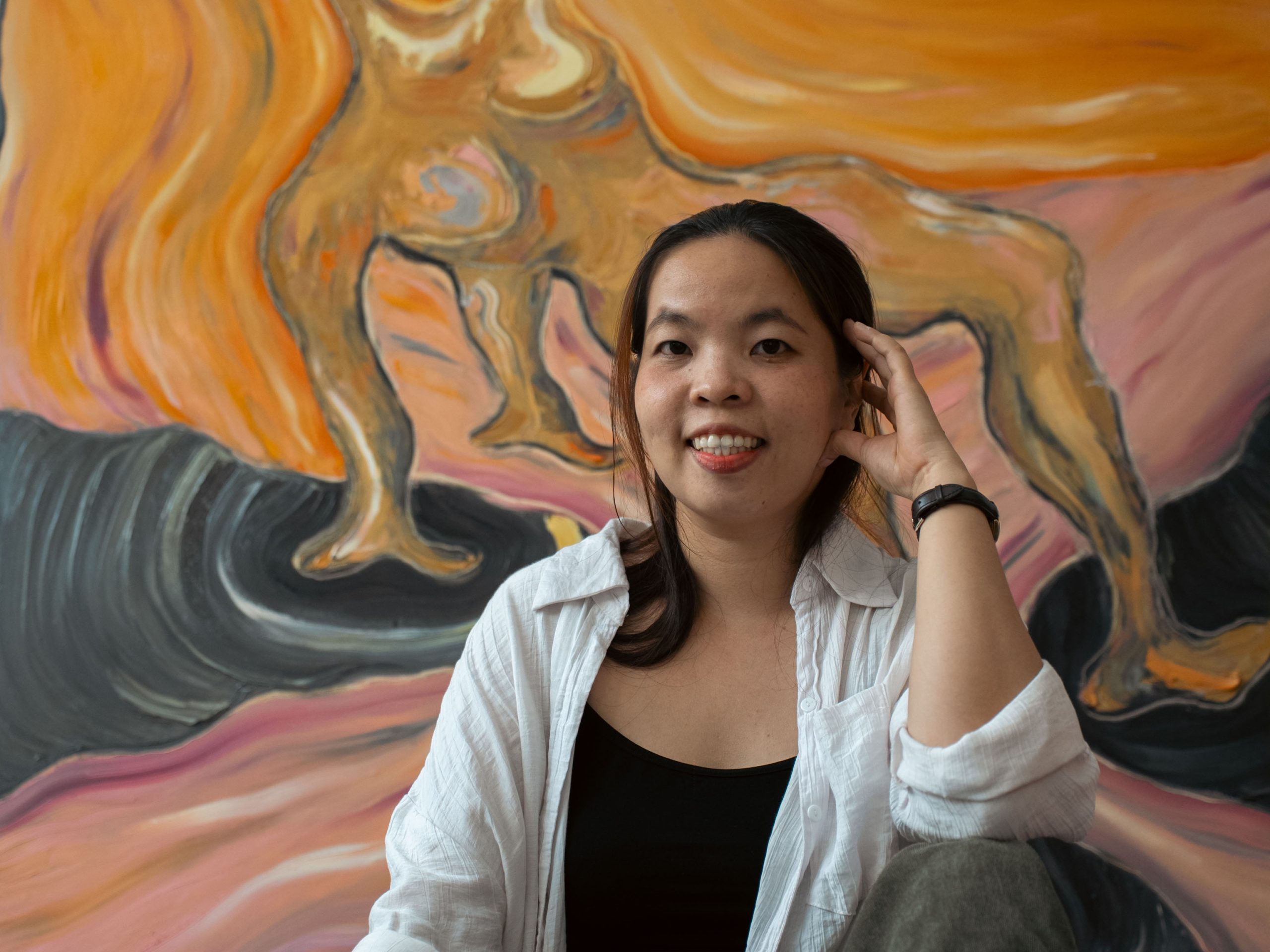
For Phuong Luong, painting is a way of saying what language cannot fully hold. Born in Ho Chi Minh City, the self-taught artist came to painting after years shaped by study, teaching and inner reflection. With master’s degrees in Linguistics and Vietnamese Studies, and experience as a university lecturer, Phuong understands the power of words. Yet in art, she found another form of expression: one that could speak more directly through colour, symbol and silence.
Although she loved art from a young age, Phuong was unable to follow that path early in life. In 2020, during the uncertainty of the COVID-19 pandemic, she experienced a period of emotional upheaval that led her back to painting. Art became a private space where she could explore her inner world, confront feelings of limitation and give shape to emotions that had long remained unspoken.
Her work is personal, but never closed. Moving between expressionism, surrealism and geometric abstraction, Phuong creates paintings that feel intense yet controlled. She often works with oil and acrylic, using strong contrasts of red, black and white to build a mood that is both dramatic and strangely calm. Curved lines, symbolic figures, geometric structures and empty spaces become part of a visual language concerned with loneliness, identity and human existence.
Her 2024 series The Woman marked the beginning of her professional artistic practice. In this body of work, the female figure becomes a vessel for many emotional states: softness, playfulness, rebellion, courage, desire and solitude. These women are not portraits of specific individuals. They are inner figures, shaped by memory, imagination and feeling. Through them, Phuong explores the many passages of life, from birth and hope to love, resistance and self-discovery.
The power of The Woman lies in its fluidity. Continuous curved lines give the figures a sense of movement and vulnerability, while the warm, forceful palette suggests energy pressing from within. Works such as The Woman Playing with the Earth, The Woman Playing with the Sun, The Woman Hugs the Moon and The Waiting Woman do not describe beauty in a conventional sense. Instead, they reveal emotional situations: a body in relation to nature, a spirit seeking freedom, a heart learning how to hope.
In 2025, Phuong’s practice moved into a quieter, more philosophical space with The Eccentric Shelves, shown at Maii Artspace in Ho Chi Minh City. Inspired by existential thought, this series reflects the fragile state of being human when faced with questions of meaning, uncertainty and isolation. The recurring motif of the eye appears within grid-like compositions, suggesting both the act of looking and the feeling of being observed.
Here, emptiness becomes as important as form. Black and grey spaces create a sense of distance, silence and psychological pressure. By placing voids at the centre and pushing images toward the edges, Phuong turns composition into a meditation on absence. The result is restrained, unsettling and deeply introspective.
Across her work, Phuong Luong treats art as a continuous narrative of the self. Her paintings do not offer easy answers. Instead, they open a space where emotion can be seen, questioned and felt. Through the body, the eye, the grid and the void, she creates a visual world that is intimate, philosophical and quietly powerful.